
Route minimum weights, and the cheap-line illusion
The estimator's best prices are real and conditional. Several lines refuse parcels below a stated weight, so the cheapest row for a 1 kg order and for a 5 kg order are different animals.
Policy examples captured 10 October 2026. Check the live terms for your order; tutorial screens show older interface examples.
Boundary two
Minimums observed on the estimator
| Line | Floor | Quoted at 1 kg | Transit |
|---|---|---|---|
| ups-Tariffless Line-electrified (US) | 2,000 g | $39.18 | 2-6 days |
| UPS Duty-Free, No Batteries (US) | 2,000 g | $39.28 | 2-6 days |
| HKUPS (UK, PL) | 2,501 g | $63.94 / $26.98 | 5-10 days |
| UK Line-B(>5kg) | 5,001 g | $16.36 | 5-12 days |
| EUB (US) | ceiling instead: 2,000 g actual | $39.35 | 15-25 days |
The estimator shows floored lines greyed with a yellow note, worded exactly like this on the UK run: the parcel weight should not be less than 5001g. The rows stay visible at any weight, which is honest and also how a 400-gram order gets priced in someone's head against a line it cannot board.
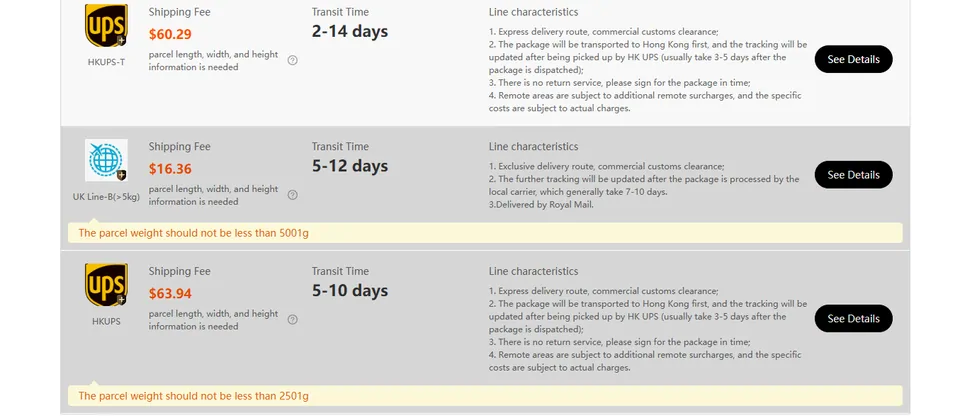
Billable window, UK Line-B(>5kg)
Below 5,001 g the quoted line stays grey however good the price looks; from 5,001 g this weight restriction is met; other route conditions still apply. The historical $16.36 row was not a usable quote for the 1 kg test parcel.
Numbers in motion
The same trap from the US side, plus the quiet multipliers
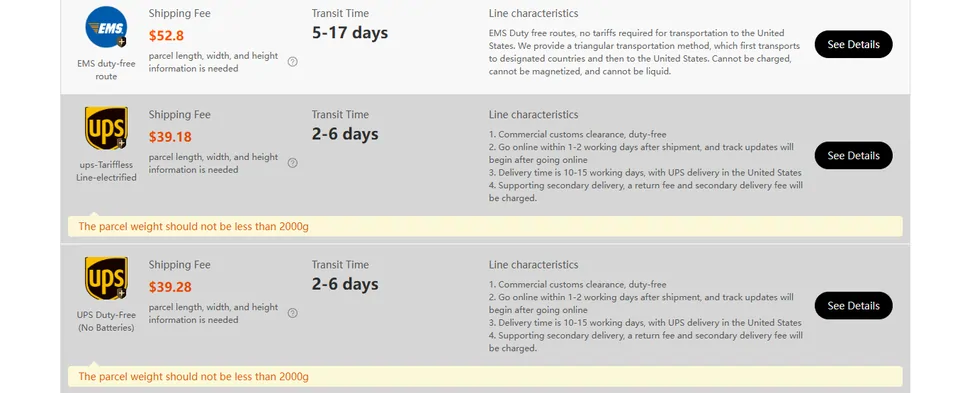
Thirteen US lines priced a 1 kg parcel that day, from $38.07 to $52.80 among the bookable rows. The spread is the point: the difference between your bookable cheapest and the greyed cheapest is the real cost of a light parcel, and it changes with every hundred grams.
Volumetric weight and the commercial threshold
Where a route uses volumetric billing, calculate length × width × height in centimetres divided by its stated divisor, then compare with actual weight as instructed by that route. The captured examples used 5000 or 8000, but the selected route decides the rule. A boxed bag full of air can bill at twice its scale weight, which can increase freight. Check whether a route’s minimum refers to actual or chargeable weight; dimensional weight does not automatically satisfy an actual-weight floor. In the other direction, the help centre warns that parcels over 10 kg, or stuffed with many identical items, are more likely to be treated as commercial at customs.
Insurance is a floor, not a promise
The captured insurance terms describe a delay benefit of 20% of shipping after a route-dependent 30- or 40-day threshold, subject to the policy’s eligibility and exclusions. It is not universal cover or a delivery deadline. Read the selected route’s loss, damage and delay terms separately, and plan for seller, warehouse and customs time as well as transit.
Compare routes after the parcel is defined
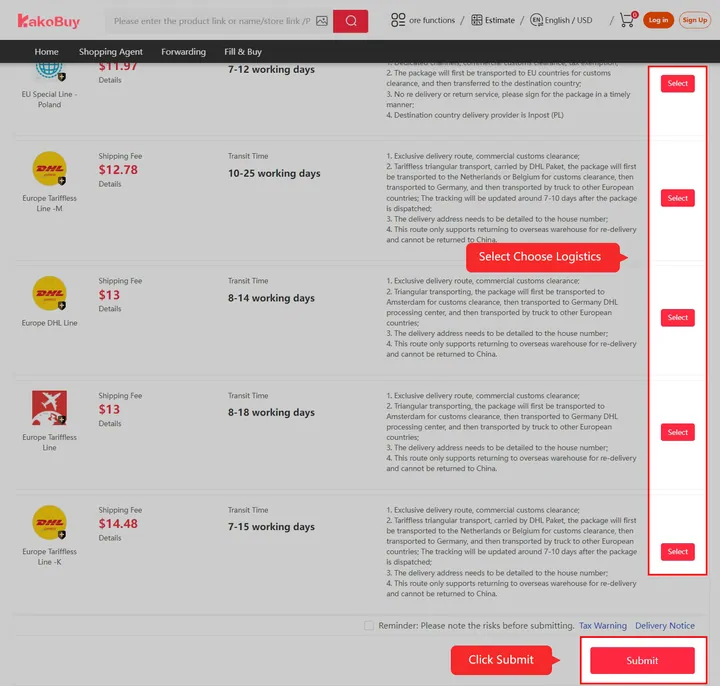
Enter destination, goods type, actual packed weight and dimensions. Read each available route for batteries, liquids, size limits, insurance criteria and tax handling. A grey row or a low quoted number does not mean that route accepts your parcel.
Keep the packaging that protects your item. Removing a box may reduce volume but can also remove useful protection; choose per item instead of using Remove All Packaging automatically. If rehearsal is available for your selected items, use its measurements to rerun the estimate.
At checkout, save the route name and terms. Transit ranges are estimates, not delivery deadlines; seller dispatch, purchasing, warehouse work and customs can add time outside that range.