
Zero service fee, and every number that stands around it
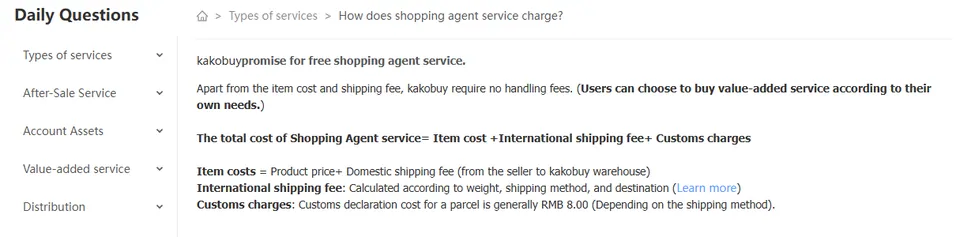
The headline is true: no agent fee on the purchase. The landed cost still collects at least five other lines, and two help articles name an 8-yuan charge without explaining how the two entries relate.
Policy examples captured 10 October 2026. Check the live terms for your order; tutorial screens show older interface examples.
The stack
The published fee lines
| Line | Published value | Reading |
|---|---|---|
| Agent or handling fee | no agent or handling fee on the purchase itself | the genuine zero in the stack |
| Customs declaration charge | RMB 8.00 per parcel, generally | named in the total-cost formula |
| Packaging consumables fee | 8 yuan per parcel | a separately named line in a separate article |
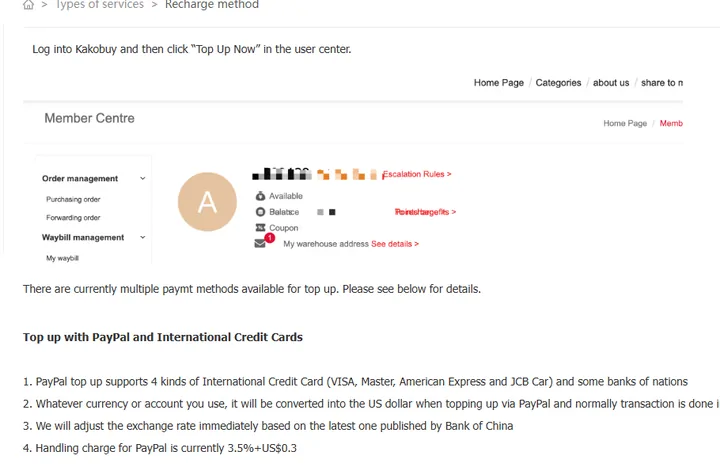
| PayPal surcharge | Official examples conflict: 3.5% or 2.9%, plus US$0.30 | Alipay and WeChat carry no handling charge |
| Historical FX / standard-service comparison | +8.5%, 8 October 2026 snapshot | historical FX / standard-service comparison; excludes payment-channel fees and is not a current quote |
| Storage extension | 10 yuan per original order per 30 days, where eligible | normal storage: 100 days from In storage; abnormal: 60 days from Signed for. Arrange any extension before the applicable deadline; cooling-off is not an automatic free extension |
The two 8-yuan rows deserve their own sentence. The help centre lists a packaging consumables fee of 8 yuan in its fee-calculation article, and a customs declaration cost of generally RMB 8.00 in its service-charge article. Nothing published states whether a parcel pays one, the other, or both, so this guide lists them separately and refuses to add them into a single number. Ask support which charge applies to your chosen route and compare it with the final itemisation.
Percentages and options
The two quiet percentages
Payment route changes the total
The captured official help pages disagree: articles 64 and 99 state 3.5% plus US$0.30, while article 65 states 2.9% plus US$0.30 and embeds an older checkout example. Use the fee shown for your payment. The operator lists no handling charge for Alipay and WeChat and an indicated 1–60 minute crediting range; your provider’s charges and conversion can still affect the total.
The retained 8 October 2026 comparison recorded +8.5% FX markup and +8.5% for FX plus the standard service fee, with the standard service fee recorded as zero. Its “all-in” field does not include payment-channel fees. These are dated observations, not a promise of the same rate today. For your order, keep the stated conversion rate, explicit payment fee, amount charged and CNY credited as four separate fields.
Optional lines that earn their keep
The captured policy lists pre-packing at 18 yuan and a 24-hour processing indication, paid photos at 2 yuan per piece, and priority purchase at 5 yuan with a four-buyer-working-hour indication. Choose an extra when it resolves a specific uncertainty. Processing indications are not guarantees, and paid photos cannot test hidden function.
Where to verify the stack
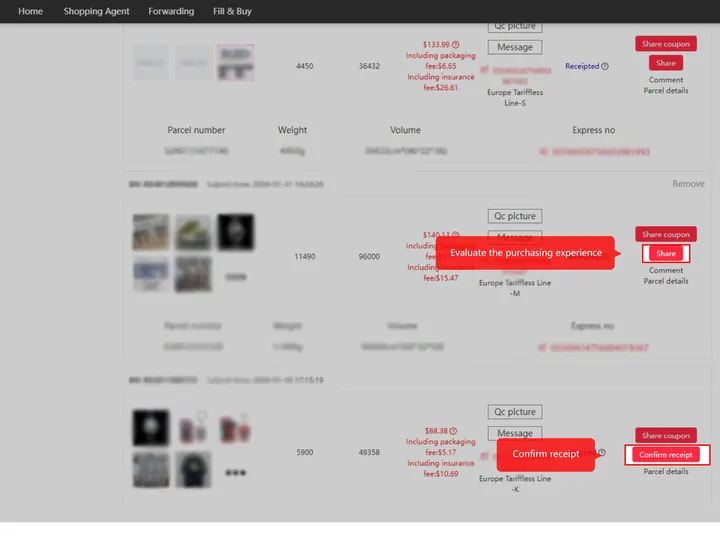
The parcel screen itemises what you actually paid: freight, packaging, insurance if taken. Screenshot it on your first order and compare against your pre-order arithmetic. The delta between the two is your personal correction factor for every order after.
A reusable budget before and after packing
- Before buying: record item cost, seller-to-warehouse freight, quantity and the final top-up conversion. Keep the displayed payment fee separate from the exchange rate.
- After stock-in: replace guessed item weights with warehouse measurements. Decide whether extra photos or rehearsal packing answer a specific unresolved question.
- At parcel submission: check billable weight, route, packaging options, insurance and included or excluded taxes. Verify the two ¥8 references against this itemisation instead of automatically adding ¥16.
- Keep a buffer: an estimate is not a payable quote. Save the accepted total and ask about an unexpected line before paying.
Dividing the amount paid in your currency by CNY credited gives your effective funding cost per CNY. It includes any fee taken from that payment, so it does not by itself isolate the exchange spread. Compare identical funding methods and amounts at the same time.
Compare the same basket, then reconcile the difference
If two payment screens credit different CNY amounts, their totals are not comparable yet. Set the same credited amount, record the final debit in your currency, and include any separate provider charge. A cheaper conversion rate can still produce a more expensive payment when a fixed fee applies.
After packing, replace only the estimates that changed: item weight becomes packed billable weight, optional packaging becomes the selected charge, and a coupon becomes a discount only if checkout accepts it. Keep the old estimate beside the final itemisation so you can identify the cause of a difference. Check the route’s weight and eligibility rules before treating that difference as a fee error.